
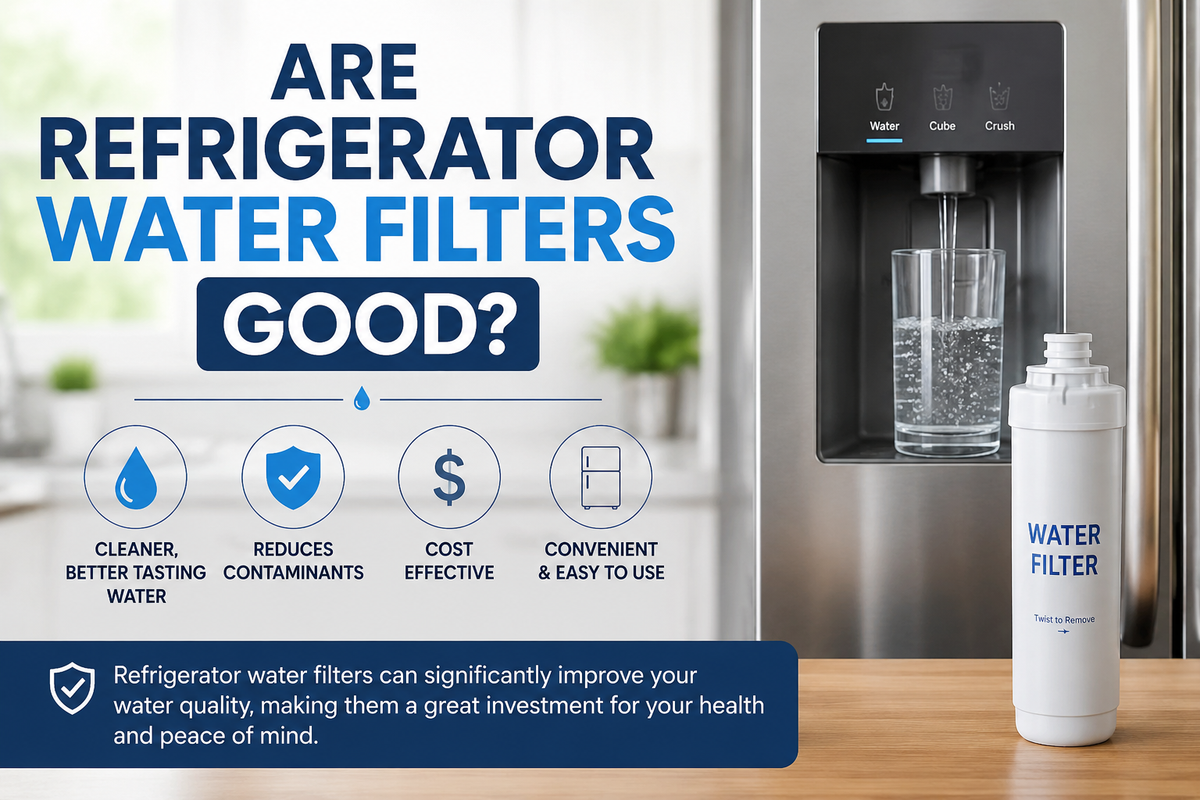
Yes, in most cases refrigerator water filters are good. They offer a convenient way to improve the taste, odor, and overall quality of your drinking water without adding another appliance to your kitchen counter. But not every filter performs the same way. Some models carry official certifications that back up their claims while others rely on generic marketing language alone.
It also helps to know what a refrigerator filter can and cannot do. These filters are not built to remove every possible contaminant from your water supply. They work best against specific issues like chlorine taste, odor, and certain sediment. If your household is on municipal water and mainly wants better tasting drinking water and ice a refrigerator filter is often a smart fit. If you have specific water quality concerns you may need to pair it with additional testing or treatment.
Are Refrigerator Water Filters Good?
For everyday households refrigerator water filters genuinely improve the drinking experience. They work quietly in the background and require no extra setup once your fridge is installed.
The biggest advantage is convenience. You never need to fill a pitcher or install a separate countertop unit. Water passes through the filter automatically every time you use the dispenser or ice maker. Most users notice a real difference in taste and odor almost immediately after installing a fresh cartridge.
That said filter quality matters a great deal. A cheap uncertified filter may only offer minimal improvement while a certified filter can reduce specific contaminants with documented results. Before you decide whether refrigerator water filters are good for your situation always check the specifications listed on the box or the manufacturer's website.
How Do Refrigerator Water Filters Work?
Most refrigerator filters rely on activated carbon. This material has a porous structure that traps chlorine, certain chemicals, and unpleasant odors as water flows through it.
Many filters also include a sediment or particle stage that physically catches larger debris like rust flecks or sand particles. Higher end filters use multi-stage filtration combining both adsorption, where contaminants stick to the carbon surface, and physical filtration, where particles are simply blocked by the filter media.
Because these technologies differ from brand to brand two filters that look similar can produce very different results. This is exactly why checking the technology and certification behind a filter matters more than judging it by appearance alone.
What Do Refrigerator Water Filters Remove?
A quality refrigerator filter typically reduces chlorine taste and odor along with common sediment and particulates. Certified models can also reduce lead and select other chemicals or VOCs. Some filters even carry certification for reducing certain cysts and microorganisms depending on their design.
It is important to understand that not every refrigerator filter removes the same list of contaminants. Manufacturers publish specific performance data sheets for each model. Always compare that documentation instead of assuming one filter performs exactly like another.
Benefits of Using a Refrigerator Water Filter
Better Tasting Water
Removing chlorine taste and odor makes everyday drinking water noticeably fresher. Many people say this is the first improvement they notice after switching to filtered water.
Cleaner Tasting Ice
On compatible refrigerators the same filtered water supplies your ice maker. That means clearer, better tasting ice cubes without any extra effort on your part.
Convenient Filtration
There is no need for a separate countertop pitcher or an under sink system. Filtration happens automatically as part of your existing refrigerator.
Easy Filter Replacement
Most cartridges twist or click into place and can be swapped out in minutes without calling a technician or plumber.
Potentially Fewer Bottled Water Purchases
A reliable filter can reduce your household's reliance on bottled water for everyday drinking which also helps cut down on plastic waste over time.
Are Refrigerator Water Filters Safe?
Yes when you use the correct filter for your model and replace it on schedule. Safety largely comes down to using a genuine or properly certified compatible filter rather than an unverified generic option.
Look for NSF or ANSI certification on the packaging. These standards confirm that independent testing backs up a filter's contaminant reduction claims. A filter that only carries general marketing language without a certification number has not been verified in the same way. Sticking to the recommended replacement schedule also matters since an old saturated filter can actually release trapped contaminants back into your water over time.
What Are the Limitations of Refrigerator Water Filters?
They Don't Remove Every Contaminant
Standard refrigerator filters generally do not remove fluoride, dissolved minerals, many types of salts, or certain microorganisms. Capabilities vary widely by model so always check the specific reduction list.
They Have Limited Capacity
Every filter eventually becomes saturated with trapped particles and contaminants. Once that happens performance drops and replacement becomes necessary.
They Don't Replace Water Testing
If you have a known water quality concern such as high lead levels or bacterial contamination a refrigerator filter alone is not a substitute for professional water testing.
They May Cost More Over Time Than Expected
Replacement cartridges add up especially if you choose expensive OEM options over comparable compatible filters. It helps to compare long term costs before committing to a specific brand.
Refrigerator Water Filter vs Bottled Water
|
Feature |
Refrigerator Water Filter |
Bottled Water |
|
Convenience |
High |
High |
|
Ongoing cost |
Filter replacements |
Repeated purchases |
|
Plastic waste |
Generally lower |
Generally higher |
|
Filtration |
Depends on filter |
Depends on brand |
|
Storage |
None required |
Requires storage |
For most households a refrigerator filter offers similar convenience to bottled water with lower long term plastic waste. Once you install the cartridge you get a steady supply of filtered water without ever carrying heavy cases home from the store. Over a year the cost of replacement filters is often lower than the cost of buying bottled water for a family of four.
Refrigerator Water Filter vs Reverse Osmosis
Refrigerator filters are designed for everyday taste and odor improvement using carbon based filtration. Reverse osmosis systems go further by forcing water through a fine membrane that can address a wider range of dissolved contaminants including certain minerals and salts.
Installation also differs quite a bit. A refrigerator filter simply slots into your existing appliance while reverse osmosis typically requires under sink installation and periodic membrane maintenance. Reverse osmosis systems usually cost more upfront and require more maintenance but they offer broader filtration capability. If your main goal is better tasting everyday water a refrigerator filter is often enough. If you have specific contaminant concerns reverse osmosis may be worth the added investment.
Cost is another factor worth weighing. A refrigerator filter cartridge is usually far cheaper than a full reverse osmosis setup and it requires no professional installation. Reverse osmosis systems demand more maintenance over time including periodic membrane changes but they can handle a broader range of dissolved contaminants that a standard carbon filter simply cannot touch.
How Long Do Refrigerator Water Filters Last?
Most refrigerator filters are rated for about six to twelve months or a specific gallon capacity, whichever comes first. Several factors affect how quickly that capacity gets used up.
Higher water usage, larger household size, poorer source water quality, and heavy ice maker use can all shorten a filter's effective lifespan. Most modern refrigerators include a filter indicator that tracks usage and time automatically so you do not have to guess when it is time for a change.
Signs Your Refrigerator Water Filter Needs Replacement
Watch for slow water flow from the dispenser, an unusual or unpleasant taste, a noticeable odor, or a change in how your ice tastes. Your fridge's filter indicator light is also a reliable signal. Once you reach the manufacturer's recommended replacement interval it is best to swap the cartridge even if you have not noticed any problems yet.
How to Choose a Good Refrigerator Water Filter
Start by confirming compatibility with your exact refrigerator model. Identify the correct filter model number either from your old cartridge or your owner's manual. Look for relevant NSF or ANSI certification and review the specific contaminant reduction claims listed by the manufacturer. Check the rated filter capacity so you know roughly how long it should last. Compare OEM and compatible options based on performance data rather than price alone and always buy from a reputable seller to avoid counterfeit cartridges.
Whether you drive an LG, GE, Bosch, Kenmore, Frigidaire, or Sub-Zero refrigerator choosing the right filter starts with matching your exact model number to a certified option. Taking a few extra minutes to compare specification sheets before you buy saves you from returns and disappointing performance down the line.
If you own a specific brand it also helps to shop within that brand's dedicated filter lineup. Our Ge Refrigerator Water Filters, Bosch Refrigerator Water Filters, Kenmore Refrigerator Water Filters, and LG Refrigerator Water Filters collections make it easy to find a certified match without guessing. Sub-Zero owners can browse our dedicated Sub Zero Water Filter collection for compatible options built specifically for those models.
Are Generic Refrigerator Water Filters Good?
Many generic or aftermarket refrigerator filters perform just as well as OEM options as long as they carry proper certification and are built for your exact model. Quality does vary between manufacturers though so it pays to check certification and compatibility details rather than choosing based on price alone. A well made compatible filter from a reputable brand like Frost Water Filter can offer the same performance as a name brand cartridge at a more reasonable cost.
Frequently Asked Questions
Are refrigerator water filters really worth it?
For most households yes. They offer noticeable taste and odor improvement with very little effort or ongoing cost compared to other filtration methods.
Do refrigerator water filters make water safer?
Certified models can reduce specific contaminants like chlorine, sediment, and in some cases lead, which can improve overall water quality.
Do refrigerator filters remove lead?
Some certified models do. Always check the specific NSF certification listed for your filter to confirm lead reduction claims.
Do refrigerator water filters remove chlorine?
Yes, chlorine taste and odor reduction is one of the most common functions of activated carbon refrigerator filters.
Do refrigerator filters remove fluoride?
Most standard refrigerator filters do not remove fluoride. Specialized filtration methods like reverse osmosis are typically needed for that.
Are refrigerator water filters better than bottled water?
They are often more convenient and produce less plastic waste over time while offering comparable or better tasting water.
How often should you change a refrigerator water filter?
Most filters should be replaced every six to twelve months or once they reach their rated gallon capacity, whichever comes first.
Can an old refrigerator filter make water taste bad?
Yes, a saturated filter can lose its effectiveness and in some cases release trapped particles back into your water.
Are generic refrigerator water filters safe?
Yes, as long as they carry proper certification and are verified compatible with your specific refrigerator model.
What is the best type of refrigerator water filter?
The best option is a certified filter that matches your exact refrigerator model and addresses the specific contaminants present in your water supply.
Final Thoughts
Refrigerator water filters can be a practical and convenient filtration solution for everyday households. Their real effectiveness depends heavily on the specific filter's technology, certification, and how closely it matches your refrigerator model. They are not designed to replace every type of water treatment system especially for households with specific contamination concerns.
Before buying any replacement filter take a moment to review its contaminant reduction claims and certification details. This simple step makes the biggest difference in how well your filter actually performs. When you are ready to upgrade Frost Water Filter offers a wide range of certified compatible filters for LG, GE, Bosch, Kenmore, Frigidaire, and Sub-Zero refrigerators. Browse our full Refrigerator Filters collection and find the right match for your model today.
Reference: Water filter overview on Wikipedia